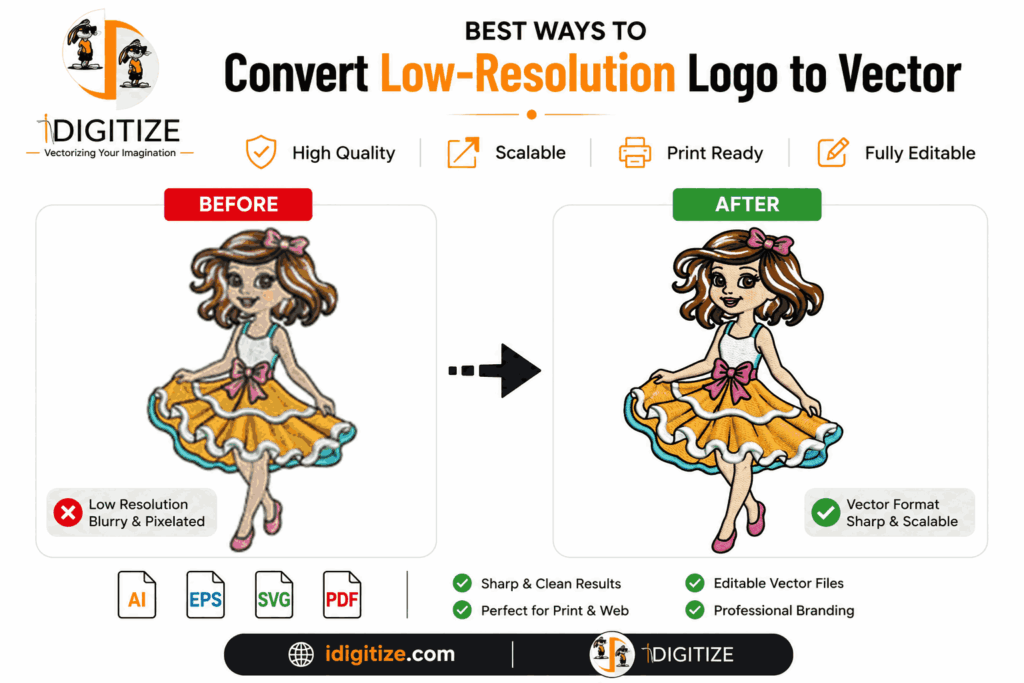
Many businesses struggle with blurry logos that look unprofessional on banners, embroidery, packaging, and marketing materials. Low-resolution JPG and PNG logos may appear acceptable on small screens, but once enlarged, they quickly become pixelated and distorted.
This creates serious branding issues.
A poor-quality logo can reduce customer trust and damage a company’s professional image. Modern businesses need scalable and print-ready artwork that looks clean across every platform.
That’s why companies need to Convert Low-Resolution Logo to Vector formats for professional use.
Vector graphics provide sharp, scalable, and editable artwork suitable for printing, embroidery, websites, packaging, and promotional products. Unlike raster images, vector logos maintain quality at every size.
In this guide, you’ll learn the best ways to convert low-resolution logos into professional vector graphics, why vectorization matters, and how businesses can improve branding quality through proper vector artwork.
What Does It Mean to Convert Low-Resolution Logo to Vector?
Converting a low-resolution logo to vector means recreating a blurry or pixelated raster image into scalable vector artwork.
Raster files include:
- JPG
- PNG
- GIF
- BMP
These images use pixels.
When enlarged, they:
- Lose sharpness
- Become blurry
- Show jagged edges
Vector graphics work differently because they use:
- Curves
- Paths
- Mathematical coordinates
This allows vector logos to:
- Scale infinitely
- Stay sharp
- Remain editable
- Produce better printing results
Raster vs Vector Graphics
Raster logos:
- Limited scalability
- Poor large-format printing quality
- Difficult editing
Vector logos:
- Fully scalable
- High-quality
- Editable
- Print-ready
This is why businesses prefer vector artwork for professional branding.
Common Vector File Formats
Professional vector conversion usually includes:
- AI
- EPS
- SVG
These formats support:
- Printing
- Embroidery
- Packaging
- Websites
- Signage
- Marketing materials
Why Businesses Need to Convert Low-Resolution Logo to Vector
Modern businesses require scalable and professional logo files.
Better Print Quality
Vector logos create:
- Sharp edges
- Smooth curves
- Cleaner details
This improves:
- Business cards
- Packaging
- Promotional products
- Large banners
Improved Embroidery Results
Embroidery machines work more effectively with clean vector artwork.
Vector conversion improves:
- Stitch accuracy
- Detail quality
- Edge clarity
This creates better embroidery for:
- Uniforms
- Caps
- Jackets
- Apparel
Stronger Branding Consistency
Businesses use logos across:
- Websites
- Social media
- Packaging
- Signage
- Vehicles
Vector graphics maintain consistent quality everywhere.
Easier Editing and Updates
Vector files allow designers to:
- Resize logos
- Modify layouts
- Change colors
- Create alternate versions
This provides long-term branding flexibility.
Professional Business Appearance
Customers notice branding quality immediately.
Professional vector logos help businesses appear:
- More trustworthy
- More modern
- More reliable
Best Ways to Convert Low-Resolution Logo to Vector
There are several methods businesses use for vector conversion. However, some methods produce significantly better results than others.
Manual Vector Tracing
Manual tracing is the best and most professional method.
Designers manually recreate:
- Curves
- Shapes
- Icons
- Typography
This creates:
- Cleaner lines
- Better accuracy
- Smoother curves
Manual tracing produces the highest-quality results.
Adobe Illustrator Vectorization
Adobe Illustrator is one of the most popular tools for vector conversion.
Professional designers use Illustrator for:
- Shape recreation
- Typography cleanup
- Color matching
- File exporting
This software supports:
- AI
- EPS
- SVG
formats.
Redrawing the Logo from Scratch
Some logos are too blurry for tracing.
In these cases, designers completely recreate the artwork from scratch.
This method improves:
- Branding consistency
- Scalability
- Professional appearance
Using High-Resolution Source Files
Better source images improve vector accuracy.
If possible, businesses should provide:
- Original artwork
- Larger PNG files
- Existing design files
This helps create cleaner vectors.
Professional Vectorization Services
Professional services provide:
- Manual tracing
- File optimization
- Color correction
- Print-ready formatting
This produces much better results than free online tools.
Expert Tips for Better Vector Conversion
Following professional tips helps businesses achieve higher-quality artwork.
Avoid Automatic Vectorization Tools
Auto-tracing software often creates:
- Rough curves
- Jagged edges
- Poor typography
Keep Logos Clean and Simple
Simple logos:
- Scale better
- Print cleaner
- Work better for embroidery
Request Multiple File Formats
Always request:
- AI
- EPS
- SVG
This ensures long-term flexibility.
Test Before Production
Always test vector files before:
- Printing
- Embroidery
- Packaging production
This prevents expensive mistakes.
Work with Experienced Designers
Professional designers create:
- Cleaner artwork
- Better typography
- More accurate branding
Common Mistakes Businesses Make
Many businesses reduce logo quality through avoidable mistakes.
Using Tiny JPG or PNG Files
Very small logos produce poor-quality vectors.
Choosing Cheap Automatic Services
Low-cost providers often rely on auto-tracing tools.
Ignoring Print Requirements
Different industries require proper file preparation.
Not Saving Editable Files
Without editable vectors, future branding updates become difficult.
Using Different Logo Versions
Inconsistent branding weakens business identity.
Real Examples and Case Studies
Apparel Brand Example
A clothing business converted its blurry PNG logo into vector artwork.
Results included:
- Better embroidery quality
- Cleaner printing
- Stronger branding consistency
Restaurant Business Example
A restaurant upgraded its low-resolution logo for signage and packaging.
Results included:
- Sharper menus
- Better signage
- More professional branding
These examples show how vector conversion improves production quality and business presentation.
Conclusion
Blurry and low-quality logos create major problems for branding, printing, embroidery, and marketing materials. Poor artwork can reduce customer trust and make businesses appear less professional.
That’s why companies need to Convert Low-Resolution Logo to Vector formats for professional use.
Professional vector conversion creates scalable, editable, and print-ready artwork suitable for websites, packaging, embroidery, signage, and advertising.
From better printing quality to stronger branding consistency, vector graphics provide long-term value and flexibility for modern businesses.
If you want sharper visuals, cleaner logos, and professional branding results, converting your low-resolution logo into vector artwork is one of the smartest investments your business can make.
👉 Upgrade your logo today with professional vector conversion services and improve your branding everywhere.
FAQs
1. What does it mean to convert low-resolution logo to vector?
It means recreating a blurry or pixelated logo into scalable vector artwork suitable for professional branding and printing.
2. Why are vector logos better than JPG or PNG files?
Vector logos remain sharp at every size and produce cleaner printing and embroidery results.
3. What file formats are used for vector logos?
Common vector formats include:
- AI
- EPS
- SVG
4. Can blurry logos be converted into professional vectors?
Yes. Professional designers can manually recreate blurry logos into clean vector artwork.
5. Why is manual vectorization better than automatic tracing?
Manual vectorization creates smoother curves, cleaner typography, and more accurate artwork than automatic software.